
A message from our founder
Why I’m building Noa
I’ve had Type 1 diabetes for 20 years, and I work as a consultant supporting the NHS to design health services. For five years I’ve helped NHS teams improve how services work, so I see the gaps from both sides: as a patient using those services and as a consultant helping to improve them.
The blood sugar is the visible part of type 1. The admin around it is constant, and it falls entirely on the patient. It breaks down into three areas.
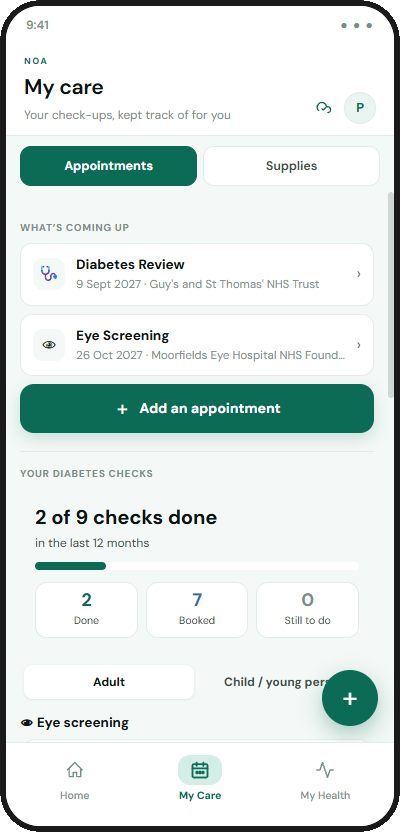
The checks. Type 1 comes with nine annual checks across several services. No single service owns all of them, and the records often don’t pass between them. Keeping track of what’s been done, where, and what’s overdue is left to me. Miss one and a complication gets caught later than it should.
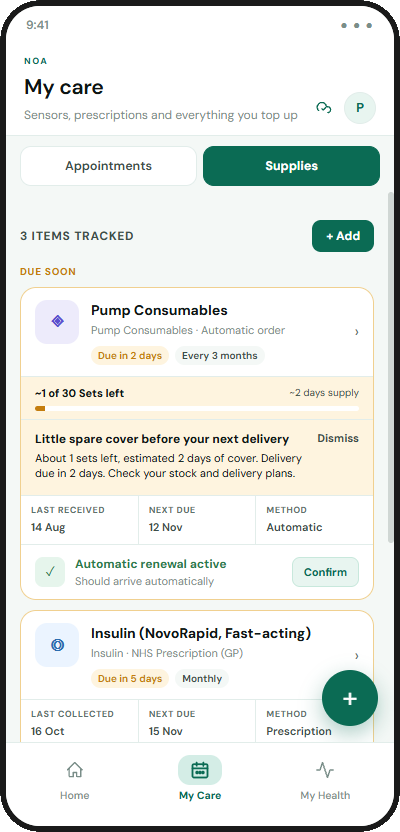
The supplies. Insulin, sensors, pump sets, strips, lancets, hypo treatment. Each arrives from a different place on a different cycle. Running low on any of them is a real problem, so a background part of my attention is always on what’s left and when to reorder.
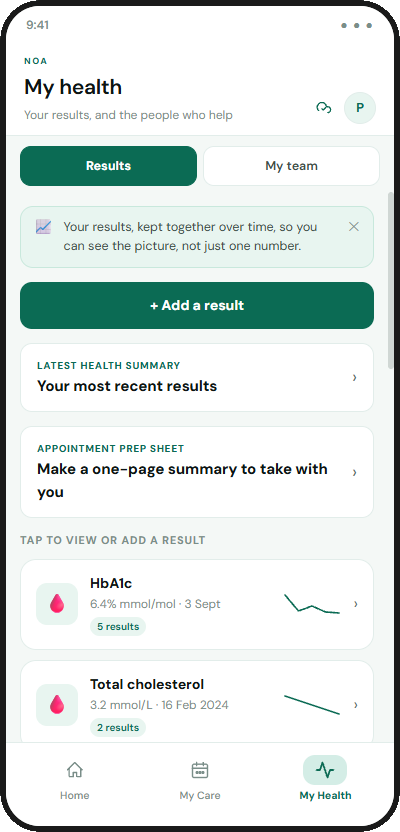
The record. Results sit in letters, the NHS App, hospital portals, and the apps on my sensor and pump. Seeing how my HbA1c has moved over years, or whether my eye screening is stable, means assembling it myself from a dozen sources.
The cost of this is not only time. It is the mental load of holding it all in your head, the stress of chasing results and reordering supplies, and the worry when something slips. Those admin failures are not separate from the condition. A missed check, a lapsed supply, a result you never saw; each makes good control harder and adds to the stress of living with type 1.
The NHS is working towards joined-up care. On current timelines that is years away, and until then the patient carries the coordination.
Noa is your type 1 health and care record, held in one place and built by you: your results and trends, your checks, your supplies, your care team. One place to see what you need, what’s due, and how things are changing, so less falls through the cracks and the condition takes up less of your head.